How Many Australians Drink Coffee? The Latest Data (2026)
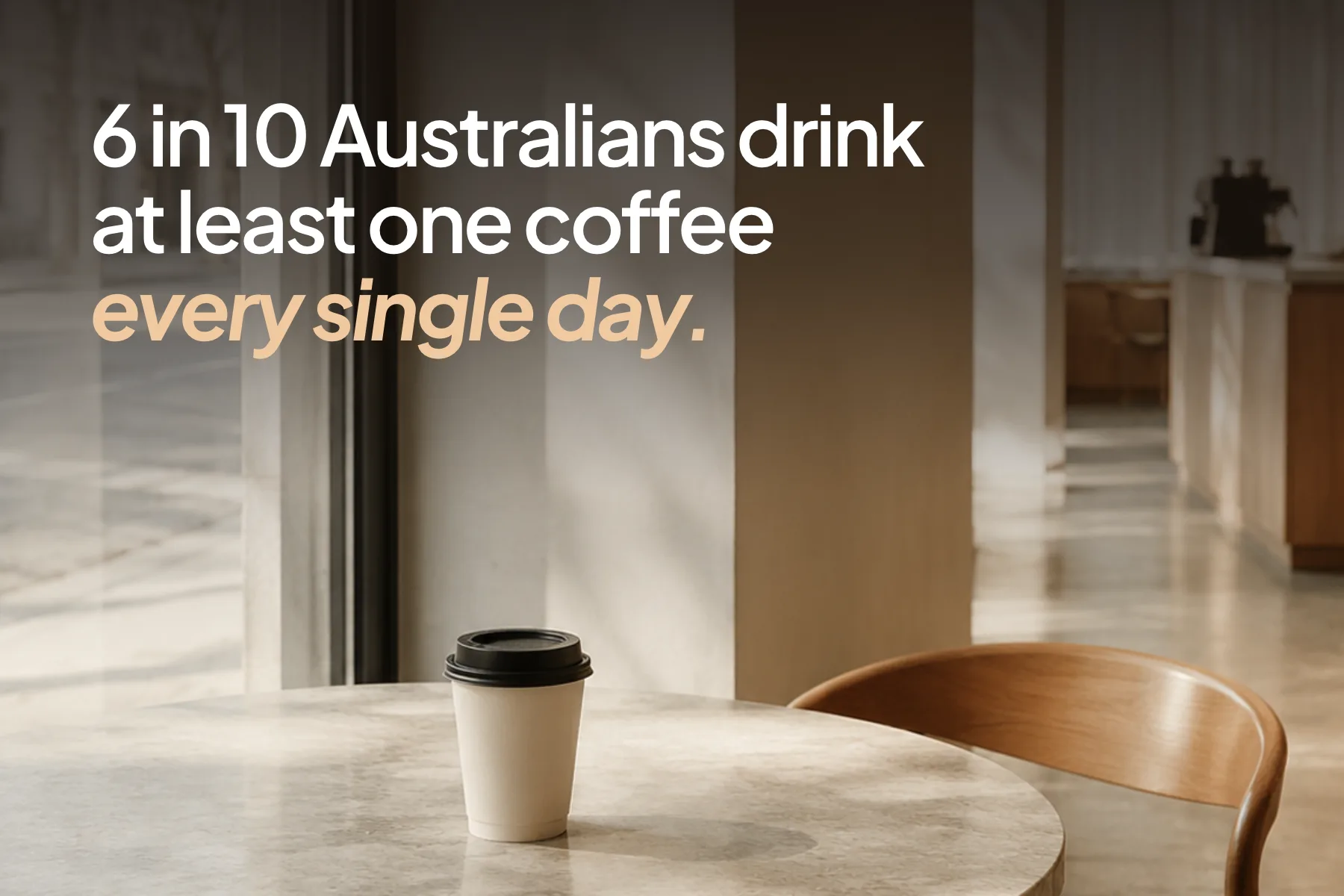
About 6 in 10 Australian adults have coffee on a given day, according to the ABS. Here is how much Australians drink, where they buy it, what it costs, and what it means for cafes. From the team behind Back Again.
If you run a cafe, the size of the coffee market is the least useful number. What matters is how many of those drinkers buy from you, and how often. Here is what the latest reliable data says about who drinks coffee, where they get it and what they pay, and then what to do with it.
The numbers at a glance
| Question | Figure | Source and year | Worth knowing |
|---|---|---|---|
| Adults who had coffee on a given day | 61.5% | ABS, 2023-24 | Includes coffee substitutes |
| Average intake | 191 g a day | ABS, 2023-24 | Per person, all ages |
| Coffee made at home vs bought at a cafe | 78% vs 32% | McCrindle, 2023 | Many people do both |
| Adults who bought coffee out of home in 3 months | 79% | Seven Miles Coffee Roasters, Dec 2024 | 519 out-of-home buyers |
| Average price of a coffee | $4.69 | Daily Brew Report 2026, June 2026 | Up 1.65% on the year |
| Average price people say they pay | $5.42 | Compare the Market, Aug 2026 | 3,078 adults, self-reported |
| Stopped buying cafe coffee, now make it at home | 29% | Canstar, Aug 2026 | 2,100+ Australians |
How many Australians drink coffee?
About 6 in 10 adults on any given day. The ABS surveyed Australians between January 2023 and March 2024 and asked what they ate and drank over the previous 24 hours. Of adults, 61.5% had coffee or a coffee substitute that day: 62.7% of men and 60.3% of women. Across the whole population, including children, it was 49.7%.
Picture 100 adults on your street. About 61 of them had a coffee yesterday.
How much coffee do Australians drink?
The ABS average is 191 grams a day of coffee and coffee-substitute drinks per person. That is the weight of the drink, not a count of cups, and it includes people who do not drink coffee at all.
For cups, the most recent figure is a Canstar survey of more than 2,100 Australians from August 2026: 34% drink one cup a day and 50% drink two or three. It does not say whether that covers everyone or only coffee drinkers, so read it as a guide.
Where do Australians drink their coffee?
Most coffee is made at home. In a 2023 McCrindle survey, 78% of Australians said they make coffee at home and 32% buy it from a cafe. The cafe share was highest among Gen Z (40%) and Gen Y (41%) and lowest among Baby Boomers (18%). Instant was the most preferred type at 41%, just ahead of freshly ground espresso at 36%.
Those who buy out of home do it often. A survey for Seven Miles Coffee Roasters, What Cafe Customers Want 2025, found that 79% of adults had bought coffee out of home in the previous three months. Of those, 73% buy from a cafe or restaurant at least weekly, rising to 86% of 18 to 34 year olds. The sample was 519 out-of-home coffee buyers, surveyed in December 2024.
So most adults have coffee on a typical day, a smaller group buys it at a cafe in any given week, and a core of regulars go often. That core is the market for most independent cafes.
Some are cutting back. Canstar's August 2026 survey found that 29% of respondents had stopped buying cafe coffee and now make it at home, and another 19% had bought a coffee machine to avoid takeaway. Canstar did not publish its full method and the survey ran while prices were in the news, so treat it as a signal, not a measurement.
What does a coffee cost?
Reported prices. The Daily Brew Report 2026, from Hey You and Westpac DataX, put the national average at $4.69 a cup in June 2026. That is up 1.65% on a year earlier, the smallest annual rise in six years. Tasmania was the most expensive at $5.44, then Queensland at $5.17 (up 7.81%, the biggest jump). Victoria was the cheapest at $4.61.
What people say they pay. Compare the Market's August 2026 survey of 3,078 adults found an average of $5.42 a cup. Canstar's was $5.90. People tend to guess higher than the prices in actual sales data, which likely explains the gap.
Cafes are also absorbing the end of card surcharges. We cover the sums in the card surcharge ban for cafes.
What this means for a cafe
Taste, price, location. When the Seven Miles survey asked what drives the choice of cafe, taste came first (73%), then price (65%), then location (54%). That held across age groups. It is a small sample from late 2024, but it matches what most owners already know.
Your biggest competitor is the kitchen counter. Coffee is a daily habit for most adults, but most of it is made at home. A cafe does not win because the market is large. It wins by being the place a person chooses, repeatedly.
Regulars are the market. If only a minority of coffee drinkers buy at cafes in a given week, the customers who come often matter far more than the occasional visitor. Find them, make it easy to come back, and notice when one goes quiet. See what our cafe data shows about the second visit, how to get repeat customers, loyalty programs that work and how to lift average spend. To be found in the first place, start with your Google Business Profile.
Know your own numbers. National averages describe the market, not your cafe. Your repeat rate and your average order tell you far more, and so does knowing what a typical cafe keeps after expenses.
If you want a loyalty card that runs itself, Back Again is a tap-to-stamp card with no app for customers, plus win-back and birthday emails. It is free until your first 50 customers, then $39 a month in Australian dollars. See how it works.
A quick guide to reading coffee statistics
- Check the year. Many figures in circulation are from 2017 to 2023.
- Check what was measured. "Had coffee yesterday", "drinks coffee daily" and "likes coffee" are three different numbers.
- Check the base. "Australians" can mean all adults, coffee buyers or survey respondents.
- Treat time-series claims with care. Some articles say coffee drinking rose from 46% in 2012 to 61.5% in 2023. The ABS says time series comparison is not possible at this level, so we would not quote it.
Frequently asked questions
How many Australians drink coffee?
About 6 in 10 adults on a given day. The ABS found that 61.5% of adults had coffee or a coffee substitute in its 2023-24 national nutrition survey.
What percentage of Australians drink coffee every day?
The ABS figure is 61.5% of adults on the day they were surveyed. That is actual intake on one day, not a count of people who drink coffee every single day. Surveys that ask about habits give higher numbers, such as 75% in a 2017 McCrindle survey.
How much coffee do Australians drink per day?
The ABS puts the average at 191 grams a day of coffee and coffee-substitute drinks per person. In an August 2026 Canstar survey, 34% said they drink one cup a day and 50% two or three.
Do most Australians make coffee at home or buy it at a cafe?
Most make it at home. McCrindle's 2023 survey found 78% make coffee at home and 32% buy it from a cafe, though many do both.
What is the average price of a coffee in Australia?
The Daily Brew Report 2026 puts it at $4.69 a cup in June 2026. Surveys of what people say they pay are higher: $5.42 from Compare the Market and $5.90 from Canstar, both in August 2026.
Which state has the most expensive coffee?
Tasmania, at $5.44 a cup in the Daily Brew Report 2026, followed by Queensland at $5.17. Victoria was the cheapest at $4.61.
Is Gen Z drinking less coffee?
Not necessarily. In McCrindle's 2023 survey, Gen Z were the least likely to say they could not get through the day without coffee (13%), but with Gen Y they were the most likely to buy from a cafe (40% and 41%).
Do Australians prefer instant or espresso coffee?
It is close. McCrindle's 2023 survey found 41% preferred instant and 36% freshly ground espresso.
Are Australians cutting back on cafe coffee?
Some are. Canstar's August 2026 survey found 29% had stopped buying cafe coffee and now make it at home. Its full method was not published, so treat it as a signal.
Why do customers choose one cafe over another?
In a December 2024 survey, taste was the top factor (73%), then price (65%) and location (54%).
Where does the "3 in 4 Australians drink coffee daily" statistic come from?
From a 2017 McCrindle survey of 1,000 Australian adults, run with coffee machine maker Jura. It found 75% say they have at least one cup a day. It is self-reported and nine years old, so we use the ABS figure of 61.5% instead.
Sources, all checked 31 October 2026: the ABS Food and nutrients, 2023-24; McCrindle's Australia's coffee trends (2023) and Australian attitudes towards coffee (2017); Seven Miles Coffee Roasters' What Cafe Customers Want 2025; the Daily Brew Report 2026 via Time Out; Compare the Market; and Canstar. For the Daily Brew, Compare the Market and Canstar figures we have seen the published coverage, not the underlying reports. Surveys use different methods, so the figures do not add up to one picture.