Loyalty Programs for Small Business in Australia: What Works and What It Costs (2026)
How to choose and run a loyalty program for a small business in Australia: stamp cards vs points, what rewards really cost, current pricing for five platforms, the Spam Act basics, and which businesses should not bother. From the team behind Back Again.
If you run a bakery, barber, boutique, gym, florist or any other business that lives on regulars, you have probably thought about a loyalty program and then put it off. It sounds like a big-business thing, with an app, a points system and a marketing team.
It is not. A working loyalty program for a small business can be a card with eight stamps on it. This guide covers how to choose one, what it really costs, and the Australian rules you need to know about.
We are the team behind Back Again, a loyalty and marketing platform for independent businesses. It is one of the options below, so we have tried to give every alternative a fair hearing, including the free one and the cases where you should not run a program at all.
Does your business need a loyalty program?
The deciding question is simple: how often does a good customer come back?
Loyalty programs reward repeat visits. They work when the gap between visits is short enough that a half-finished card still feels worth finishing, and they stop working when it is not. These are rules of thumb from how loyalty programs behave in practice, not research figures:
| Your customers typically come back | Examples | What suits you |
|---|---|---|
| Every week or two | Bakery, deli, butcher, juice bar, takeaway | A stamp card with 6 to 10 stamps |
| Every three to six weeks | Barber, florist, pet groomer | A shorter card (4 to 6 stamps), or a spend-based reward |
| Every two to three months | Salon, beauty, physio, vet | Reward rebooking and referrals instead |
| A few times a year or less | Mechanic, tradie, accountant | Referral rewards. A stamp card will not work |
| Irregular, big baskets | Boutique, homewares, gifts | Spend-based: "$10 off when you have spent $200" |
If you are in the top two rows, keep reading. If you are further down, skip to "If your customers do not visit often" near the end.
The four kinds of loyalty program
Stamp cards (visit-based). "Buy 8, get the 9th free." Every visit earns a stamp, regardless of spend. The big advantage is that everyone understands it in two seconds, which matters at a counter with a queue behind. The downside is that a $3 purchase earns the same stamp as a $30 one.
Points per dollar. "One point per $1, redeem 100 points for $10 off." Rewards bigger spenders, and suits retail with varied baskets. The downside is complexity. Customers do not know what 340 points is worth, and your staff have to explain it.
Spend thresholds. A middle path: "Spend $200, get $10 off." Easy to explain, rewards spend, and works for retail or services with higher prices.
Paid membership or discount clubs. Members pay a fee for ongoing benefits, such as a monthly coffee subscription or a gym-style pass. This is a different business model rather than a loyalty program, so we leave it out of what follows.
For most counter-based small businesses, a stamp card wins on simplicity. Choose points or thresholds if your prices vary a lot between sales.
What a reward really costs you
This is the number people skip. Here is how to work it out for any reward.
A "free item after N paid purchases" reward costs you 100 divided by N dollars for every $100 your members spend. The free item costs you its menu price, since it is a sale you did not make.
| Reward | Cost per $100 members spend |
|---|---|
| Free item after 6 purchases | about $16.70 |
| Free item after 8 purchases | $12.50 |
| Free item after 10 purchases | $10.00 |
| $10 off after spending $200 | $5.00 |
That is the sticker price of the reward. Whether it pays for itself depends on whether it changes behaviour, meaning members visit or spend more than they would have without it.
Here is a worked example, not a benchmark. Say your gross margin is 60%, and your reward costs $10 per $100 members spend. For the program to break even, members need to spend about 20% more than they otherwise would (the formula is reward cost divided by margin minus reward cost, so 10 ÷ 50). A reward costing $5 per $100 needs only about 9% more.
If your business has spare capacity, such as an empty chair at 2pm on a Tuesday, the real cost of a free service is lower than its price. If your diary is full, it is the full price. Use the one that matches how busy you are.
Digital or paper?
Paper punch cards are cheap, and some customers love them. Their problem is not the cardboard. It is that a paper card tells you nothing about your customers. You cannot see who has stopped coming, you cannot send a birthday message, and when a card goes through the wash, the customer's progress goes with it.
A digital card does the same job and also gives you a contact list. That list is the real asset, because it lets you bring people back. We compared the two in paper punch cards vs digital loyalty.
What to compare before you choose
Five questions that separate the options:
- Does your customer have to download an app? Many people will not install one for a single business. Look for options that use a browser, a tap or a phone wallet instead. We cover how that works in loyalty without an app.
- How does the price grow? Some platforms charge a flat fee. Others charge by location, or by how many loyalty "visits" you record, which means the bill rises as the program succeeds.
- Is it tied to your till or booking system? If the program lives inside your POS, changing POS can end it, along with your member list.
- Do you get email addresses you can use? A stamp card that does not capture contact details only does half the job.
- Can you change the reward? You will want to adjust it after a few weeks, and it should not need a support ticket.
What the main options cost
Prices below are from each vendor's own page, checked on 24 October 2026. For feature detail, see our comparison of five platforms, which is written for cafes but covers the same tools.
| Platform | Price | Notes |
|---|---|---|
| Loyverse | Free | Loyalty is included in the free plan, but it is built into Loyverse POS. Paid add-ons are priced in US dollars |
| Back Again | Free to 50 customers, then $39/month AUD | Flat price, no per-location or per-visit tiers |
| Stamp Me | $49, $79 or $199/month AUD | Single location on every plan, 30-day free trial, one-off $15 for each program beyond two |
| Square Loyalty | From $49/month | Square says price depends on your locations and monthly loyalty visits, with a 30-day free trial |
| Loopy Loyalty | $25, $69 or $95/month | 15-day free trial. The pricing page does not name the currency, and we have taken it to be US dollars, so confirm before you sign |
Two things the table does not show. First, the cheapest option is not automatically the best, because a program nobody joins costs you the subscription and returns nothing. Second, if you already pay for booking or POS software, check whether it includes loyalty before you buy anything. Some do, and a free feature you will actually use beats a better one you will not.
The rules you need to know
You are collecting customers' names, emails and birthdays. A few Australian rules apply. This is a plain-English summary, not legal advice.
Email and SMS marketing (the Spam Act). You need consent from each person before sending marketing messages. The Australian Communications and Media Authority (ACMA) says express consent is best practice, and it can be given in person, on a form or with a tick box. You must keep a record of who agreed, when and how. "Inferred" consent is shakier: ACMA says it generally does not cover marketing after a one-off purchase. Every marketing message must also identify your business and include an easy unsubscribe, which you must honour within five working days. In practice, a loyalty sign-up that explicitly says "send me offers" is the clean way to do this.
Privacy. The Privacy Act mostly does not cover businesses with a turnover of $3 million or less, per the OAIC, but there are exceptions, including businesses that trade in personal information and health service providers. The OAIC page was last modified in September 2024, so check the current position. Whether or not it applies to you, having a short privacy policy and not selling customer details is good practice.
Setting one up in an afternoon
- Pick one reward you can afford. Use the table above. One reward, simply worded.
- Pick the number of stamps from your visit rhythm. Weekly regulars: 8 to 10. Monthly: 5 or 6.
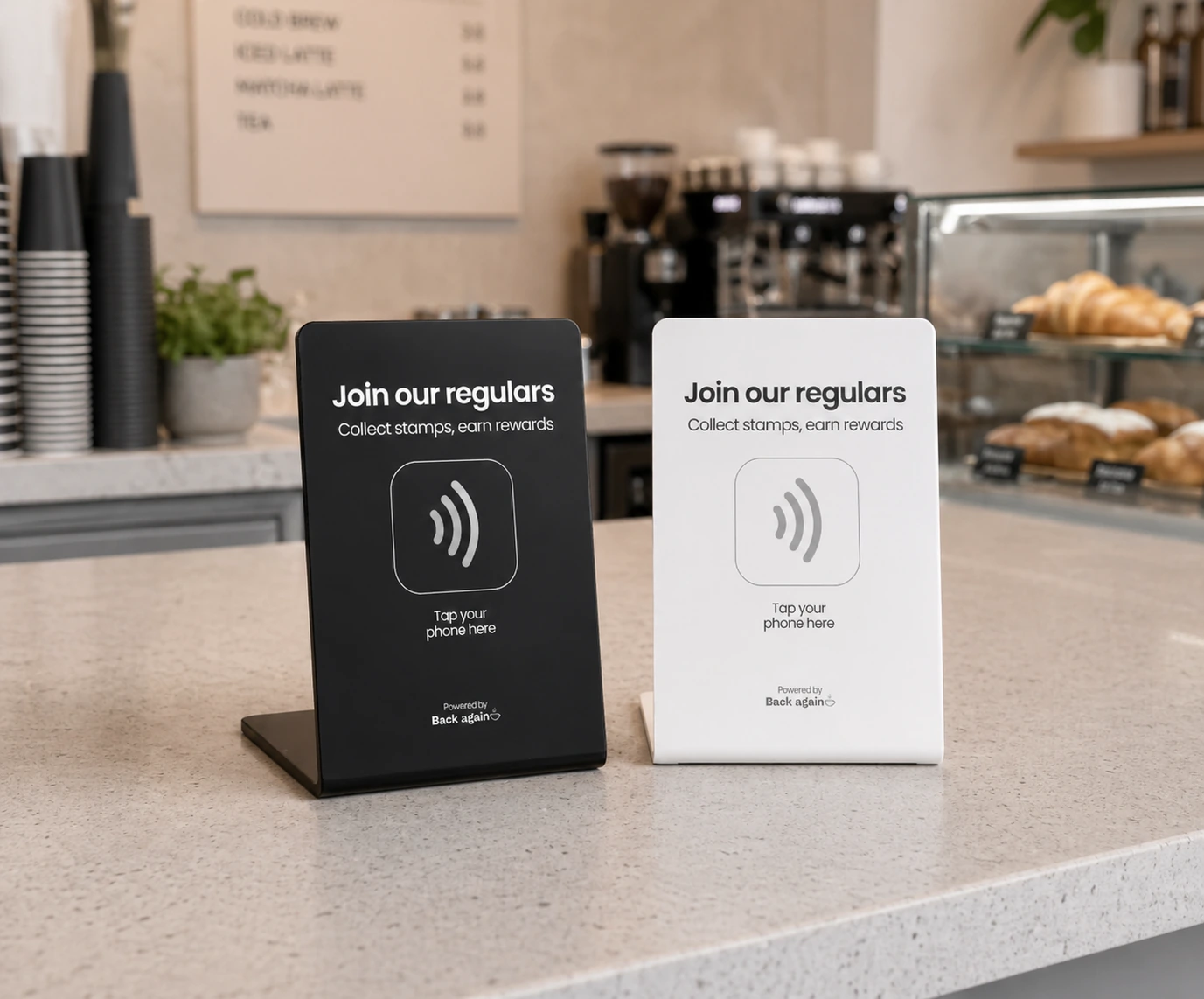
- Make joining take under ten seconds. A QR code or a tap sign at the counter, not a form. Every extra field costs you sign-ups.
- Say yes to the question at the till. A sign helps, but a staff member saying "are you on our card?" is what actually gets people to join. Give staff a line to say.
- Run it for eight weeks, then look. Count how many customers joined, how many came back and how many got to a reward. Adjust, and only then change anything.
- Add the win-back after a month. (More on this in our guide to getting repeat customers.) A single message to people who have gone quiet is usually where a loyalty list pays for itself. We wrote about the two emails worth sending, which apply to any business with a customer list.
Mistakes that sink small-business loyalty programs
Making the reward too far away. If a customer would need six months to earn it, they will stop trying at the halfway mark. A reward that feels reachable beats a generous one that does not.
Rewarding the wrong thing. A free product with a high menu price and no extra sale attached is the most expensive way to say thank you. Pair the reward with a paid item where you can.
Collecting nothing but stamps. If you do not capture a way to contact people, you have built a paper card on a phone.
Never telling anyone. A program that is not mentioned at the counter attracts almost nobody. The sign is a reminder; the staff do the work.
Changing the rules too often. Customers who have half a card will notice. Make changes at the start of a card, not the middle.
If your customers do not visit often
If you are a salon, a clinic, a mechanic or a tradie, a stamp card will feel like a chore for your customers. What helps instead:
Reward the rebooking. "Book your next appointment before you leave and get $10 off today" costs you less than a discount and puts the next visit in the diary.
Reward referrals. A thank-you for each new customer a client brings in. For businesses with long gaps between visits, this is usually worth more than any points scheme.
Stay in touch. An email timed for when they are due back, such as "it has been eight weeks since your last visit", does what a stamp card would have done.
Where Back Again fits
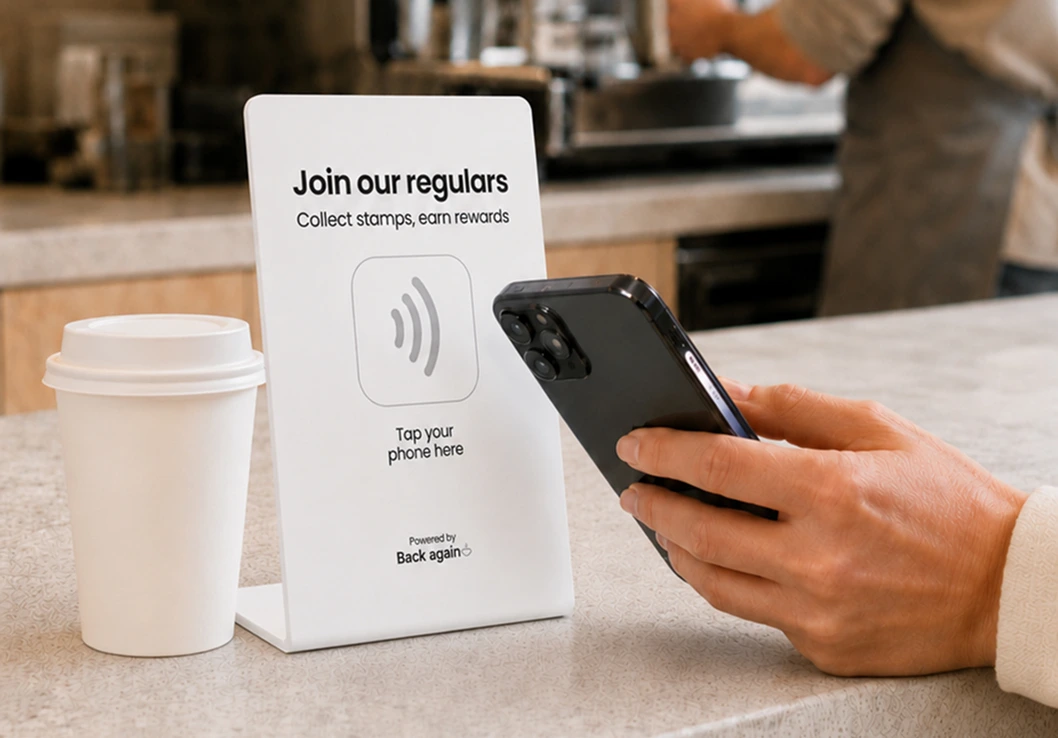
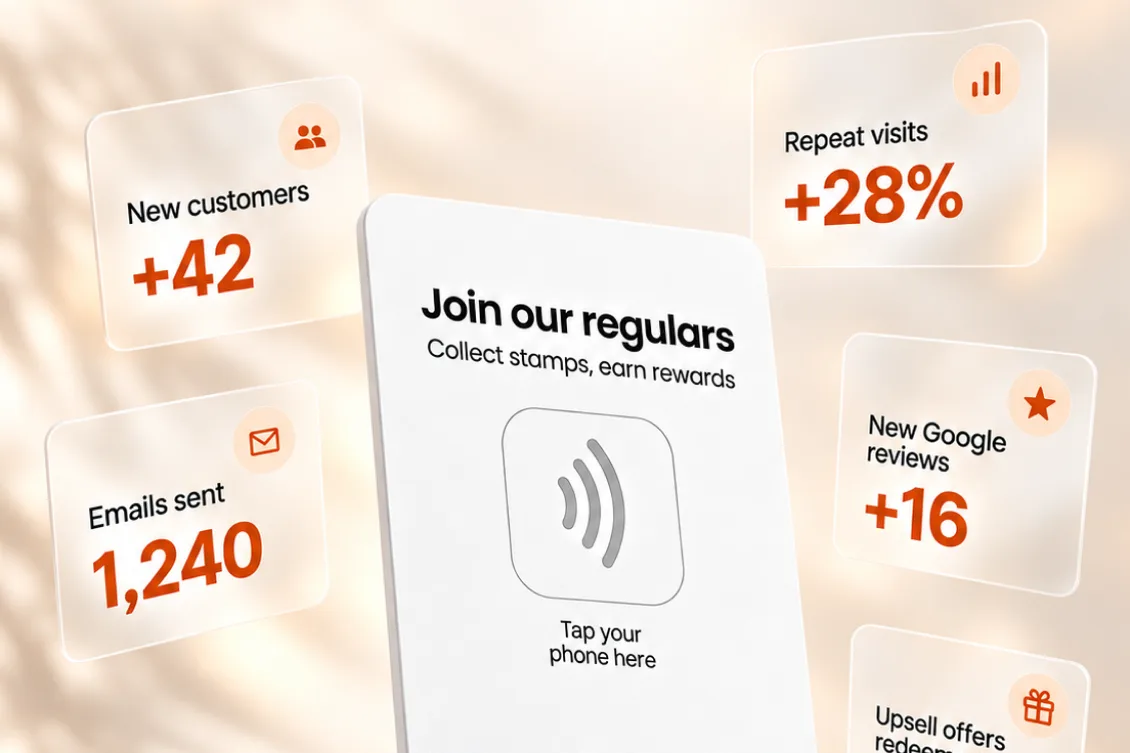
Back Again is a loyalty and marketing platform for independent Australian businesses that live on regulars. A customer taps a sign at your counter, their loyalty card opens in their phone's browser, and they collect a stamp. There is no app to download and nothing for them to remember.
What you get on the one plan:
- A tap-to-stamp card. Set your own reward and stamp count, and change them any time.
- Win-back emails. When a customer has not been in for a set number of days, they get a message with an offer attached. You choose the number of days.
- Birthday emails. A personalised offer sent on their birthday.
- Timed offers. A deal that expires, for a quiet day or a slow week.
- A Google review prompt shown right after a stamp, using your own review link. Here is how to get more Google reviews the right way.
- A flat price. Free until your first 50 customers, then $39 a month in Australian dollars, however many customers, stamps or locations you have. No contract.
It suits any business with a counter or till where customers can tap a sign, and who come back every week or month: bakeries, barbers, delis, butchers, juice bars, florists, pet shops, boutiques, gyms with a front desk and more. Because it does not connect to your till, it works whatever POS or booking system you use, and it survives a change of system.
Three limits worth knowing. It sends email only, with no SMS or push notifications. It needs somewhere to put the sign, so it is not built for businesses that work from a van or a customer's house, or whose customers book online and never stand at a counter. And it is Australia only for now.
If a free till is your priority, Loyverse is the better starting point. If you want SMS and a deeper toolkit, Stamp Me is worth a look. If you want a card your customers can start using in ten seconds, see how Back Again works.
Frequently asked questions
Do small businesses need a loyalty program?
Not all of them. A loyalty program helps businesses whose customers come back often, such as bakeries, barbers and delis. If your customers visit only a few times a year, rewarding referrals and rebookings usually works better.
What is the best loyalty program for a small business in Australia?
For most counter-based businesses with weekly or monthly regulars, a simple digital stamp card works best, because customers understand it immediately. The right platform depends on whether you want free software tied to a till (Loyverse), a flat monthly price with no app (Back Again), or deeper features at a higher price (Stamp Me, Square Loyalty).
How much does a small business loyalty program cost?
Software runs from free to around $50 a month for most small businesses, and up to $199 a month for the top Stamp Me plan. The bigger cost is the rewards: a "free item after 8 purchases" reward costs about $12.50 for every $100 your members spend.
Is there a free loyalty program for small businesses?
Yes. Loyverse includes loyalty in its free plan, but it needs you to use Loyverse as your till. Back Again is free until your first 50 customers.
Are digital loyalty cards worth it?
For most small businesses, yes, because they give you something paper cannot: a way to contact customers who have drifted away. Whether they pay off depends on your reward costing less than the extra visits it brings.
Do customers need an app?
Not necessarily. Some platforms, including Stamp Me, use an app. Others use a phone wallet or a browser link instead. Fewer steps for the customer usually means more sign-ups.
Stamp card or points: which is better for a small business?
A stamp card is simpler and suits businesses with regular, similar-priced purchases. Points suit businesses with varied basket sizes, such as retail, because they reward spend.
How many stamps should a loyalty card have?
Match it to how often customers come back. For weekly regulars, 8 to 10 stamps works. For customers who visit monthly, 5 or 6 is more realistic. The reward should feel reachable within a couple of months.
Can I email customers who join my loyalty program?
Yes, if they have consented. Under the Spam Act you need consent before sending marketing, you must keep a record of it, identify your business, and include an unsubscribe that you honour within five working days. A sign-up that clearly says "send me offers" is the cleanest way to get consent.
Does the Privacy Act apply to my small business?
The Privacy Act mostly does not cover businesses with a turnover of $3 million or less, but there are exceptions, such as businesses that trade in personal information and health service providers. A short privacy policy is a good idea either way. Confirm your own position with a professional.
Can I run a loyalty program without a POS system?
Yes. Several platforms, including Back Again, Stamp Me and Loopy Loyalty, work without being connected to your till. The trade-off is that staff or customers do the stamping rather than it happening automatically at checkout.
Where that leaves you
Start by working out how often your best customers come back. If it is every few weeks or sooner, pick one simple reward you can afford, make joining take ten seconds, and make sure the sign-up captures an email with consent. Run it for eight weeks, then look at the numbers. If your customers come back only a few times a year, skip the stamp card and reward rebookings and referrals.
If a tap-to-stamp card with no app sounds right, see how Back Again works or the pricing. If it does not, we hope the rest of this guide still helps you pick something that does.
Sources: platform pricing from Stamp Me, Square, Loopy Loyalty, Loyverse and our own pricing page, all checked 24 October 2026. Feature details (apps, wallet passes, POS requirements) are from our September 2026 platform comparison. Spam Act guidance from ACMA and privacy guidance from the OAIC, checked 24 October 2026. Reward costs and the break-even example are worked examples, not benchmarks: run the same sum with your own prices and margin. This is a plain-English summary, not legal or financial advice. Vendors change pricing often, so confirm before committing.