How to Get Repeat Customers for Your Small Business in Australia (2026)
How to turn first-time customers into regulars: measure your repeat rate, capture a way to contact every customer, give them a reason to return, and send one message when they go quiet. With worked examples by business type and the Australian rules. From the team behind Back Again.
Every small business has a leaky bucket. New customers come in through advertising, word of mouth, Google and passing foot traffic. Some of them come back and many do not, and nobody can say which, because most businesses never count.
This guide is about the second half: what happens after the first visit. It applies to any business that depends on customers returning, such as a bakery, barber, boutique, gym, florist or tradie. It is practical and Australian, and it does not rely on made-up statistics. Where we give numbers, they are worked examples you can rerun with your own.
We are the team behind Back Again, a loyalty and marketing platform for independent businesses. It is one tool among the ways to do this, and we say where it fits at the end. If you are looking for the opposite problem, getting new people through the door, start with our guide to how to attract more customers or Google reviews for small business.
First, measure your repeat rate
The business-owner version of "what gets measured gets managed" is simple. Before you change anything, find out how many customers come back.
Repeat rate is the share of customers who visit again within a set window. You pick the window based on how your business works. A barber might use 8 weeks, a bakery 4 weeks, a florist 3 months.
Here is a worked example, not a benchmark. Say 200 new customers visited in March. By the end of April, 50 of them had come back. Your 60-day repeat rate is 25%. The other 150 are customers you paid, one way or another, to find, and who did not return.
The University of Rhode Island's small business development centre suggests tracking a few simple numbers: how often customers return, average order size, and the number of repeat customers over a set period. It gives examples by business type: restaurants track repeat visits, retailers track purchase frequency, and service businesses track renewals, referrals and repeat appointments.
How to count if you have no system. Your till, booking software or invoicing tool probably already knows customer names or emails. Export a month, and see how many appear again in the following two months. If you have nothing, a paper card or a loyalty app will start giving you the numbers within weeks.
Step one: capture a way to contact every customer
This is the step most businesses skip, and everything else depends on it. If you cannot contact a customer, you cannot bring them back. You are relying on them to remember you, which they will do for a while and then stop.
For most businesses, that means an email address. The question is how to get it without a clipboard that nobody fills in.
Tie the address to something the customer already wants. A customer who wants to keep their loyalty progress will give an email address. A customer who wants a receipt, a booking confirmation or their order status will give one too. Compare that with "join our newsletter", which asks for a favour and gives nothing back.
Things that tend to fail:
- A sign-up sheet by the till. There is a queue, the pen does not work, and handwriting turns half the emails into typos.
- Collecting addresses from wifi logins. The customer typed an address to get online, not to hear from you.
- Buying a list. It is worse than useless, and the Spam Act puts the responsibility on you.
The rule you must follow: consent. Australia's Spam Act says you need consent before sending marketing messages. The ACMA says express consent is best practice and can be given in person, on a form or with a tick box, and that you must keep a record of who agreed, when and how. Inferred consent is less reliable, and the ACMA says it generally does not cover marketing after a one-off purchase. Every marketing message must identify your business and include an easy unsubscribe, honoured within five working days. A sign-up that says plainly "yes, send me offers" is the clean way. We cover this in more depth in email marketing for cafes, which applies to any business with a customer list.
Step two: give them a reason to come back soon
A good first visit does not guarantee a second. The second visit is the hardest, because the customer has to choose you again over every other option, and nothing has yet made you a habit.
Make it easy to see there is something waiting for them. This is where a loyalty card or a "next visit" offer does its job. It turns "I might go back" into "I am halfway there".
Give them a head start. Behavioural research suggests that people are more likely to finish a card that already has some progress on it. In a well-known study by Nunes and Dreze, published in 2006, car wash customers were given either an 8-stamp card with none filled, or a 10-stamp card with 2 already stamped. Both needed eight purchases. The redemption rate was 34% for the head-start card and 19% for the plain one. It was one study at one car wash, so treat it as a useful idea to test, not a guarantee. In practice it means a welcome bonus, such as double stamps on the first visit.
Match the reward to the gap. If your customers come back weekly, a card that needs 12 visits will take three months and many will give up. We cover this in loyalty programs for small business, including a table of card lengths by how often customers return.
Use the point of sale. A barber or salon can book the next appointment before the customer leaves. A shop can hand over a card with a reason to return. A tradie can offer a service reminder. The best moment to secure the return visit is the end of the first one.
Do not reserve your best offers for new customers. The URI centre makes the same point: your existing customers should not be the last to hear about a special. Regulars who see a stranger get a better deal than them tend to notice.
Step three: reach out when they go quiet
Customers rarely leave dramatically. They stop coming, and you do not notice, because a busy business cannot spot one missing face. By the time you realise, they have found somewhere else.
A win-back message catches this. It goes to customers who have not visited in a set number of days, and gives them a small reason to return.
When to send it. Match it to your natural gap. If customers usually return every two weeks, a message after four is sensible. If they usually return every two months, wait ten weeks. Too early and you look pushy, and too late and they have gone.
What to offer. Something small, specific and time-limited. "Your next coffee is on us until Friday" is easier to act on than "10% off". The deadline matters because it turns "sometime" into "this week".
What to say. Short, warm and human. For example:
Subject: We have not seen you in a while
Hi Sarah,
It has been a few weeks since your last visit, and we wanted to say we miss having you in. Your next one is on us if you drop by before Friday.
See you soon, Dave
Is it worth it? A worked example, not a benchmark. Say 60 of your customers have gone quiet, and a win-back offer costs you $5 each time someone uses it. If just 3 of the 60 return and spend $25 each, that is $75 of sales for $15 of offers. The message to everyone else costs nothing, and the offer only costs money when it works.
The same Spam Act rules apply here: consent, a clear sender and an unsubscribe.
What brings them back, by business type
Different businesses have different reasons for customers to return. Here is where to put your effort.
| Business | Typical gap | What tends to bring them back |
|---|---|---|
| Bakery, deli, juice bar, takeaway | Days to weeks | A stamp card, a welcome bonus, a win-back after a few weeks |
| Barber, groomer, florist | Weeks | Booking the next visit before they leave, a reminder when they are due |
| Salon, beauty, physio | Months | Rebooking at the appointment, a reminder, referral thank-yous |
| Boutique, homewares, gifts | Irregular | A second-purchase email, spend-based rewards, new-arrival messages |
| Tradie, mechanic, cleaner | Months to years | Maintenance reminders, a follow-up after the job, referrals |
| Gym, studio | Weekly, until they stop | A message when attendance drops, a milestone, a friend offer |
These are typical patterns, not research figures. The point is to design around how often your customers actually need you.
Mistakes that waste the effort
Discounting everything to everyone. It teaches customers to wait for a sale and costs you margin on people who would have come anyway. Make offers specific and time-limited.
Making the program complicated. If a customer needs to ask how it works, most will not bother. One reward, in one sentence.
Emailing everyone about everything. A monthly newsletter nobody asked for is a good way to be unsubscribed. Send fewer, more relevant messages: a win-back, a birthday offer, a real announcement.
Never looking at the numbers. Check your repeat rate every month or two. It tells you whether anything you tried worked.
Forgetting the basics. A loyalty card does not rescue a bad experience. Good service, a clean shop and doing what you promised are what make the first visit worth repeating.
Ignoring feedback. Ask customers what would bring them back, and act on it. Short surveys, a conversation or a reply to a review all count.
Where Back Again fits
Back Again does the three steps for businesses with a counter or till and customers who return every week or month, such as bakeries, barbers, delis, florists and shops.
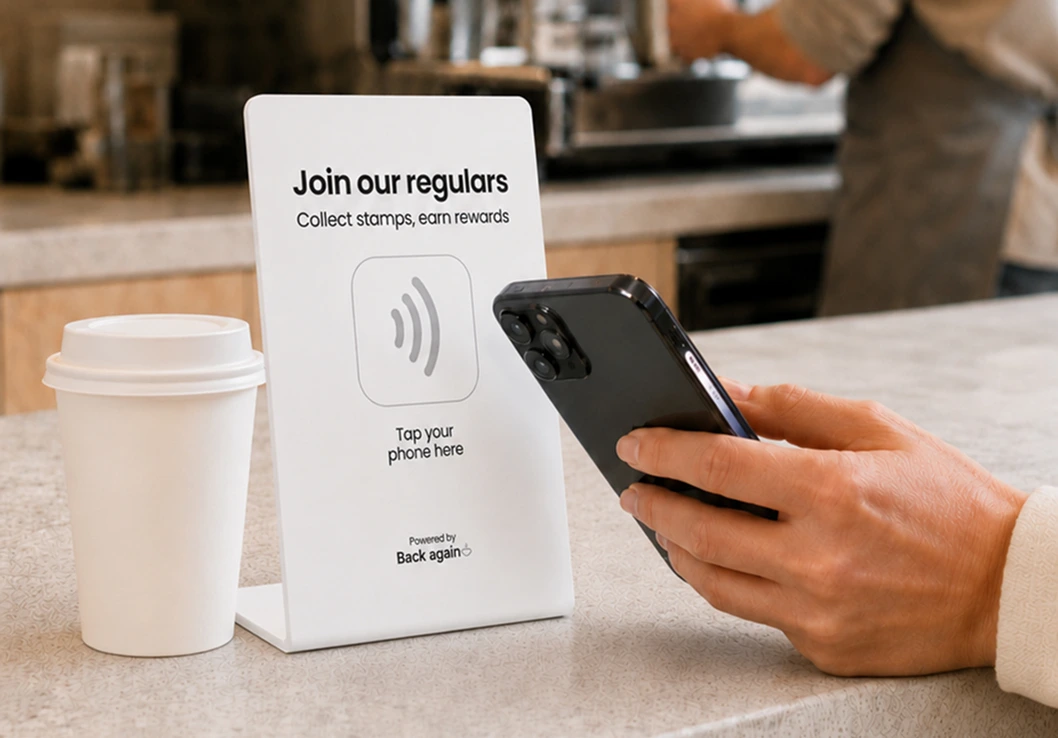
- Capture. A customer taps a sign at your counter and their loyalty card opens in their browser. Saving their progress is why they give an email address, so there is no separate sign-up. No app to download.
- Reason to return. A stamp card with a reward you choose, an optional welcome bonus that doubles the stamps on a first visit, and timed offers for slow days.
- Win-back. An automatic email to customers who have not visited in a set number of days. You choose the number, and it can send a time-limited offer with it. Birthday emails go out automatically too.
It is free until your first 50 customers, then $39 a month in Australian dollars, with no lock-in. It sends email only, no SMS or push, it needs somewhere to put the sign, and it is Australia only for now. See how it works.
If you would rather use something else, the principle holds with any tool: collect a contact, give a reason, and follow up when they go quiet. Our small business loyalty guide compares the options.
If you are weighing up how much of the market buys coffee out of home in the first place, see how many Australians drink coffee.
For what our own cafe data shows about when customers decide to come back, see how to get first-time customers to come back to your cafe.
Frequently asked questions
How do you get repeat customers for a small business?
Do three things in order: capture a way to contact every new customer (usually an email, with consent), give them a reason to come back within their normal gap, and send one message when they go quiet. Measure your repeat rate first so you know whether it is working.
How do you keep customers coming back?
Make returning easy and rewarding. Book the next visit before they leave, run a simple loyalty card with a head start, and follow up when they have not been in for a while. Service quality gets them to the second visit, but a system keeps them.
What makes customers keep coming back?
A good experience first, then a reason to return and a reminder. Customers drift away from businesses they liked, mostly because nothing prompted them to come back. A loyalty card, a booking reminder or a well-timed message fills that gap.
How do you convince a customer to come back?
Contact them with something specific and time-limited, such as "your next coffee is on us until Friday". Keep it short and personal, and only send it to customers who have agreed to hear from you.
How can I improve customer retention in my business?
Start by measuring your repeat rate over a window that suits your business. Then capture contacts, give customers a reason to return, and set up an automatic message for those who go quiet. Check the number again every month or two.
What is a good repeat customer rate?
It depends heavily on the type of business, so we do not quote a benchmark. A café and a mechanic will have very different numbers. The useful comparison is your own rate over time.
How do I get repeat customers if I have no customer list?
Start collecting contacts now, tied to something the customer wants, such as saving loyalty progress, a booking confirmation or an order update. Ask for consent to send offers. In a month or two you will have the beginnings of a list.
Do loyalty programs bring repeat customers?
They can, when the reward is reachable and the card is easy to join. A card that takes months to finish, or needs an app, often loses people. We cover how to design one in our small business loyalty guide.
What is the 80/20 rule in customer retention?
It is a rule of thumb that a large share of your revenue comes from a small share of your customers, often quoted as 80% from 20%. The exact split varies by business, so check your own: list your customers by spend and see how much the top fifth account for.
What are the three R's of customer retention?
One common version is retention, related sales and referrals: keep customers, sell them more, and get them to bring others. It is an informal framework rather than a standard, and other lists exist.
Can I email past customers to bring them back?
Yes, if they have consented. Under the Spam Act, marketing messages need consent, a clear sender identity and an unsubscribe you honour within five working days. A sign-up that clearly says "send me offers" is the cleanest way to get consent.
How do I attract customers to a small business in the first place?
Get found on Google, collect reviews and give people a reason to walk in. Our guides on Google reviews for small business and attracting customers cover it.
Where that leaves you
Count how many customers come back, and write the number down. Then make sure you can contact every new customer, give them a reason to return within their normal gap, and set up one message for the ones who go quiet. None of it needs to be clever. It needs to be consistent.
If you want that to run on its own, see how Back Again works.
Sources: the ACMA's guidance on avoiding spam, the University of Rhode Island Small Business Development Center's guide to customer retention, and Nunes and Dreze (2006), "The endowed progress effect", Journal of Consumer Research 32, as summarised by Generally Thinking, all checked 31 October 2026. The repeat rate and win-back figures are worked examples, not benchmarks. This is a plain-English summary, not legal advice.
Read next
How to Get More Google Reviews for Your Small Business in Australia (2026)
Loyalty Programs for Small Business in Australia: What Works and What It Costs (2026)