Do You Need a POS System for Your Cafe? An Honest Buyer's Guide
What a cafe POS system actually costs in Australia, why the merchant rate matters more than the monthly fee, when an upgrade is genuinely worth it, and the one thing no POS will do for you. Written by a company with no POS to sell you.
Search for a cafe POS system and every result is written by someone who sells one, or by an affiliate paid per referral. That is not a conspiracy, it is just who has a reason to write the article.
We sell a loyalty and marketing platform for cafes, and we deliberately do not integrate with any POS. That is a genuine limitation of ours, and we will come back to it. It also means we are the only party in this comparison with nothing riding on which till you choose.
So here is the version we would give a friend opening a cafe: what these things actually cost in Australia, when upgrading is worth it, and the part of the decision nearly everyone gets backwards.
You probably already have one
A point of sale system is three jobs bundled together: it takes the order, it takes the money, and it keeps a record of both.
If you have a card terminal and a way of ringing up a flat white, all three jobs are already being done. A modern POS does them on the same device and gives you reporting on top. That is the upgrade you are actually considering, and it is worth being clear about it, because "do I need a POS" and "should I replace the one I have" are very different questions with very different answers.
For a counter-service cafe, the honest answer to the second one is often no, or not yet.
What a cafe POS system actually costs in Australia
Four separate costs, and owners usually compare only the first.
The software licence. The monthly fee. Square's POS is free on its entry plan, with Plus starting from $40 a month per Square's Australian pricing page. Lightspeed Restaurant runs $79, $179 or $359 a month for Starter, Essential and Premium. Loyverse is free, with paid add-ons.
The hardware. One-off, and smaller than people expect. A Square Reader is $65, a Stand $149, a Terminal $329, a Register $1,099. Tap to Pay on a phone is free. Lightspeed does not publish hardware pricing.
The merchant rate. The percentage taken out of every card payment. Square charges 1.6% on in-person tapped or inserted cards in Australia, 2.2% online. Lightspeed's pricing page mentions integrated payments but does not publish a rate.
The switching cost, later. Not on anyone's pricing page. Menu rebuild, staff retraining, a fortnight of small errors, and whatever you lose that lived only inside the old system.
Now put a real cafe's numbers through it. Two hundred customers a day at $6.50 average is $39,000 a month of card sales.
| What you pay | Per month on $39,000 of card sales |
|---|---|
| Square POS software, Plus plan | $40 |
| Merchant fees at 1.6% | $624 |
| Terminal hardware | $329, once |
The card rate costs about fifteen times the software licence. Every hour spent comparing a $40 plan against a $79 plan is an hour spent on the fourth-largest number on the page.
Run it the other way to see the scale. Shaving 0.2 of a percentage point off your rate saves $78 a month, or $936 a year. The gap between Square Plus at $40 and Lightspeed Starter at $79 is $468 a year. So the rate is worth exactly twice the plan choice, and it is the number nobody publishes prominently.
The four realistic options
Square. Cheapest to start, and the entry plan genuinely costs nothing per month. The hardware is cheap, setup is same-day, and you will not need anyone to install it. The catch is that it gets expensive as you add things: loyalty, marketing, extra features all arrive as separate monthly line items, and the pricing is per location. For a single counter-service cafe it is the sensible default and we would say so.
Lightspeed Restaurant. A full hospitality system, and priced like one. $79 a month gets you one register on the Starter plan; almost everything beyond the basics is an add-on. An additional register is $39, inventory $99, a kitchen display $40 per screen, reservations $69. A cafe with table service, a kitchen and stock to control can justify it. A cafe with a counter and a coffee machine is buying a fit-out it will never use.
Loyverse. Free, and more capable than free usually means: POS, dashboard, kitchen display, customer display, and a loyalty program, at no monthly cost. The add-ons are per store and priced in US dollars, and the one most cafes hit first is Unlimited Sales History at $9 a month, because the free plan limits how far back you can look. If you are opening on a tight budget, it is a real answer rather than a consolation prize.
Staying on what you have. The option missing from every comparison article, including, usually, the ones that claim to be honest. If your current setup takes orders and money without failing, the upgrade has to earn its cost. Sometimes it clearly does. Often the reason an owner is shopping is that reporting frustrates them once a month, which is a real problem but not a $179-a-month one.
When an upgrade is genuinely worth it
Four situations. Notice how many of them describe a cafe rather than a restaurant.
You have table service. Open tabs, courses, moving an order between tables, splitting a bill six ways. This is the single strongest reason to buy a proper hospitality POS, and it is the reason most counter-service cafes do not need one.
You have a kitchen sending real food. Order routing to a screen or printer stops the verbal relay that goes wrong at 12:40 on a Saturday.
You have more than one site. Consolidated reporting, one menu pushed everywhere, comparable numbers between sites. Worth paying for. Watch the per-location pricing, which is where the total quietly triples.
You have stock that walks. Beans, retail bags, packaged food. If you are guessing at what you have, inventory pays for itself. Most cafes are not really in this position, and buy the module anyway.
If none of the four describe you, the upgrade is a preference rather than a need. That is a fine reason to buy something, but price it honestly as one.
The one thing no POS will do for you
Here is the limitation we said we would come back to, and it cuts both ways.
A POS is a system of record. It tells you, precisely and after the fact, what was sold. What it has no opinion about at all is whether anybody comes back.
That distinction is easy to miss because the reporting looks like insight. You can see that Tuesday afternoons are quiet. You cannot see that the man who came in four times a week for a year stopped six weeks ago, because he does not appear in a report about what was sold. He appears as an absence, and nothing in a POS surfaces an absence.
This is not a criticism of POS software. It is a description of what the category is for. But it is the reason that "which POS should I get" and "how do I get people coming back" feel like the same question and are not.
So should loyalty live inside it?
Two of the three systems above include some loyalty at no extra cost, and we should say so plainly rather than hope you do not notice. Loyverse's free plan has a loyalty program in it. Lightspeed's base plans list loyalty features. Square sells Square Loyalty as an add-on at $49, $99 or $149 a month per location, banded by activity.
If the built-in option is free and you are staying on that POS forever, use it. That is a real recommendation and it costs you nothing to test.
Two things make cafes look elsewhere.
The pricing can rise as the program works. Square's bands count loyalty visits, where a visit is an enrolment, a point earned or a reward redeemed. Thirty members a day earning points is 900 a month, which is the middle band. Sixty a day puts you past 1,500 and on $149. Those are ordinary numbers for a cafe doing a couple of hundred coffees a day, which means a successful program costs three times what a neglected one does.
Changing POS ends the program. When loyalty is a feature of the till, the members and their history live in the till. Cafes change POS more often than they plan to, and on that day you are asking your regulars to start from zero. A good portion will not. We went through this trade-off properly in do you need a POS with loyalty built in, and specifically for Square in Square Loyalty alternatives for cafes.
There is also the enrolment problem, which is the one that actually kills these programs. POS loyalty needs a staff member to ask for a phone number or an email at the counter and type it in. That ask happens at your busiest moment, so during a rush it gets skipped, and once it is skipped the data goes patchy and the program dies of neglect rather than any decision. Nobody puts that on a feature list.
Four things that quietly fail
Choosing on the licence fee. You now know the arithmetic. The rate is worth about twice the plan difference, and fifteen times it in absolute dollars.
Buying the module you will use once. Inventory, reservations, a customer-facing display. Each is $40 to $99 a month, forever, and the enthusiasm for using them lasts about five weeks. Add them when a problem exists, not in case one does.
Integrations that need a developer. "Integrates with everything" means an API exists. Lightspeed prices raw API access at $169 a month, which tells you who that door is for. If a plan depends on connecting two systems, get the connection working before you sign, not after.
Letting the POS choose your loyalty program. The default is not a decision, and it is the one part of this stack that holds your customer list. Pick the till on how it handles your floor, then decide separately who keeps the relationship with your regulars.
Where that leaves you
For most counter-service cafes: stay on the cheapest thing that works, get your merchant rate reviewed this week, and spend the money you were going to spend on a POS upgrade on something that changes behaviour rather than recording it.
Buy the proper hospitality system when you have table service, a kitchen, a second site, or stock you cannot account for. Not before.
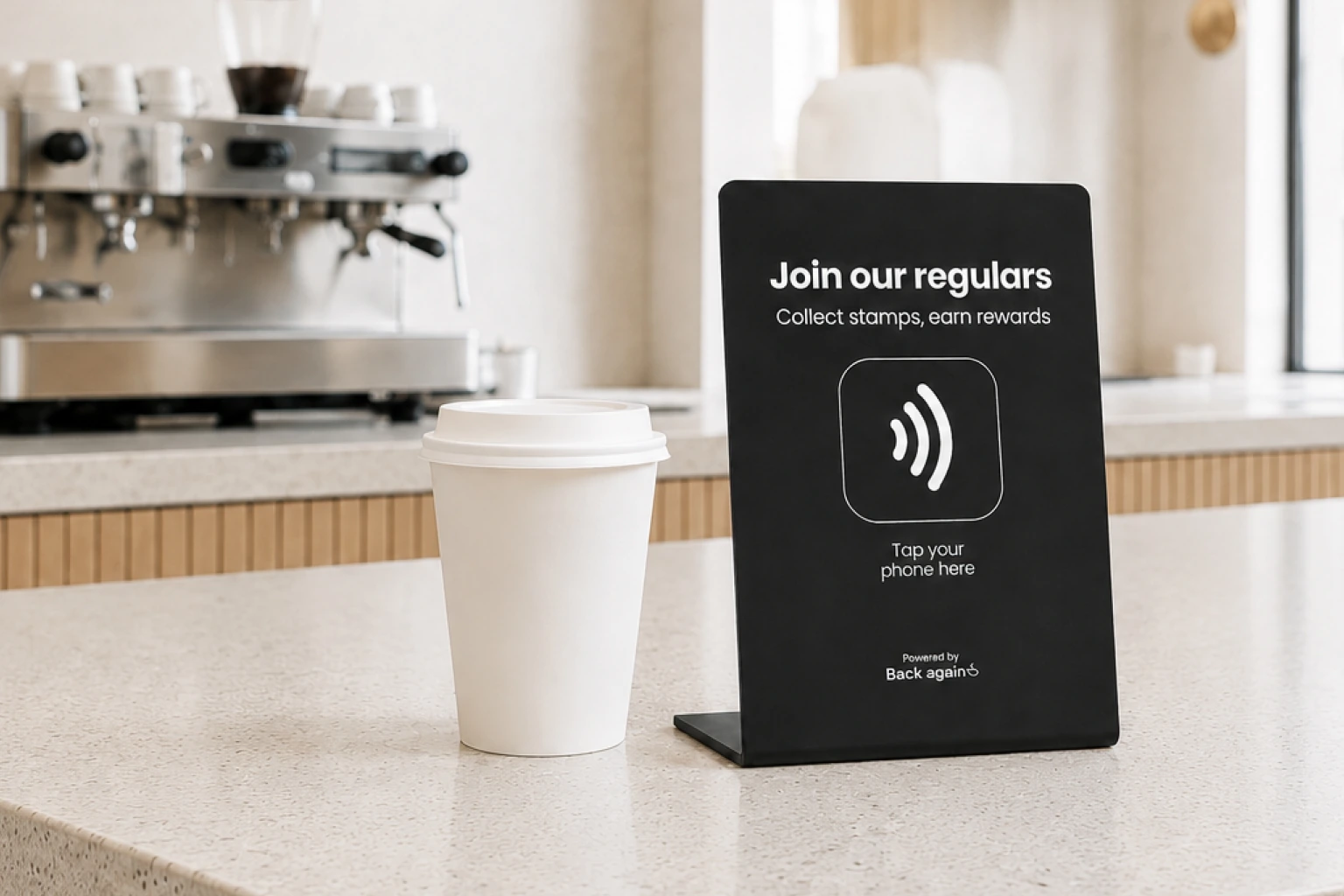
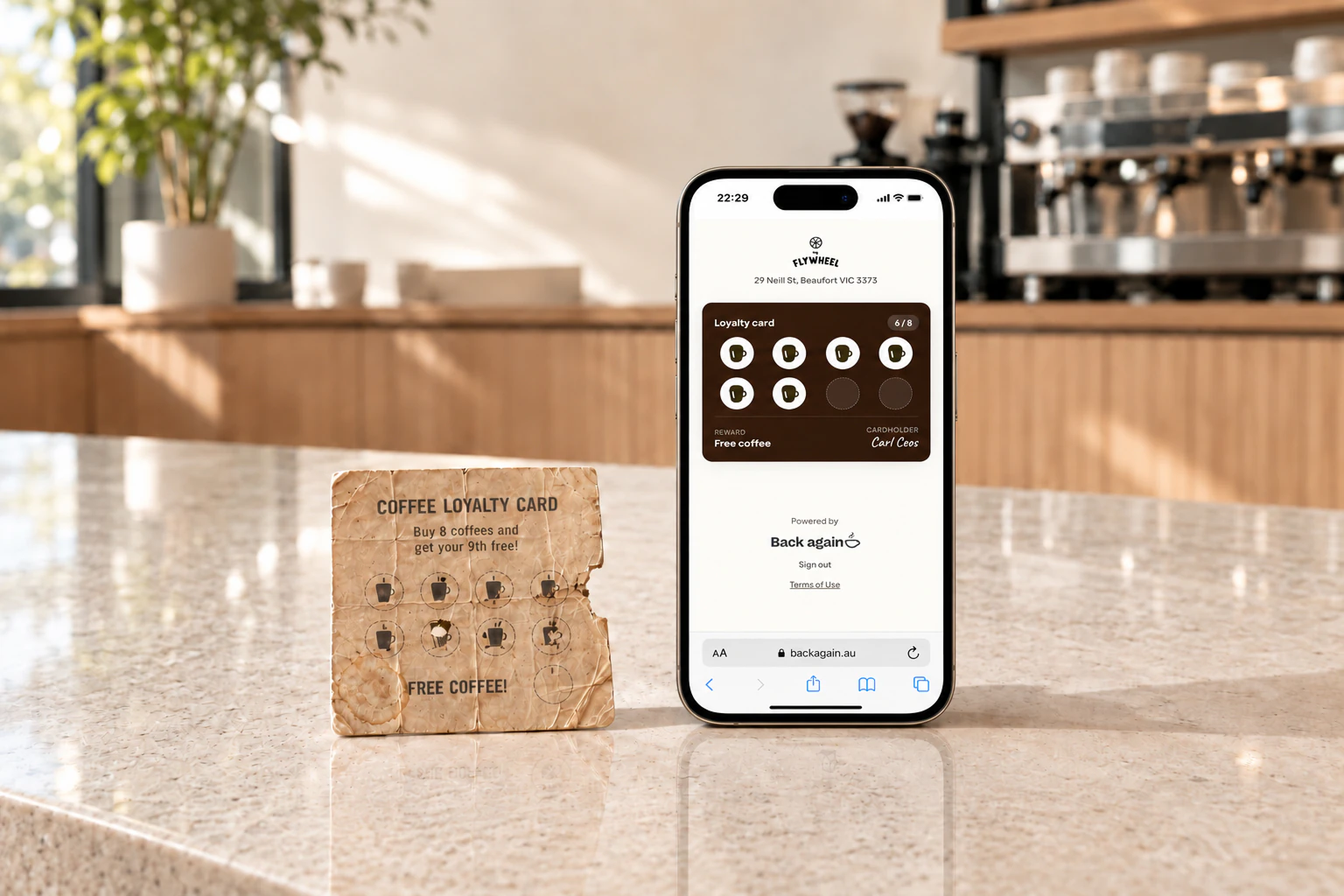
Back Again is the other half of that: a tap-to-stamp loyalty card that sits beside your till instead of inside it, so changing POS never touches it, and your customers never download an app. It also does the things a POS structurally cannot, like emailing a regular who has quietly stopped coming. Free until you have 50 customers, then $39 a month AUD flat. See how it works or the pricing.
If you want the wider comparison of loyalty options rather than tills, we compared the main platforms available to Australian cafes, including the ones that are not us.