The Best Marketing for Cafes in 2026: 8 Methods That Actually Work
Practical marketing methods that work for independent cafes. Retention math, loyalty programs, email automation, Google reviews, social media, and more. Written by the team behind Back Again.
Most cafe marketing advice online is either generic ("post on Instagram!"), unsustainable ("run Facebook ads at $50 CPMs!"), or written by people who've never watched a barista deal with a Monday morning rush. This post is different because it's written by us, the team behind Back Again, a marketing and loyalty platform for independent cafes. We work with cafe owners every day and see what actually drives repeat visits, and what quietly doesn't.
We'll cover eight methods, in rough order of return-on-effort for a typical independent cafe. Most of these are free or nearly free. All of them are things you can start doing this week.
The math no one shows you first
Before any tactics, spend two minutes on the numbers, because they determine which marketing actually pays off.
A regular customer who visits your cafe twice a week and spends $6 per visit is worth around $624 per year in revenue. On typical hospitality margins, that's roughly $220 to $280 in gross profit back to your cafe.
A new walk-in who comes once and doesn't return is worth one transaction, minus the cost of whatever attracted them (an Instagram ad, a discount, a flyer). Often that first transaction is net-zero or a loss.
The ratio matters. If your cafe has 200 regulars, getting each of them to visit one extra time per month equals 2,400 extra transactions a year. To match that with new-customer acquisition, you'd need to attract and convert several hundred new walk-ins. That's not impossible, but it's dramatically harder and more expensive.
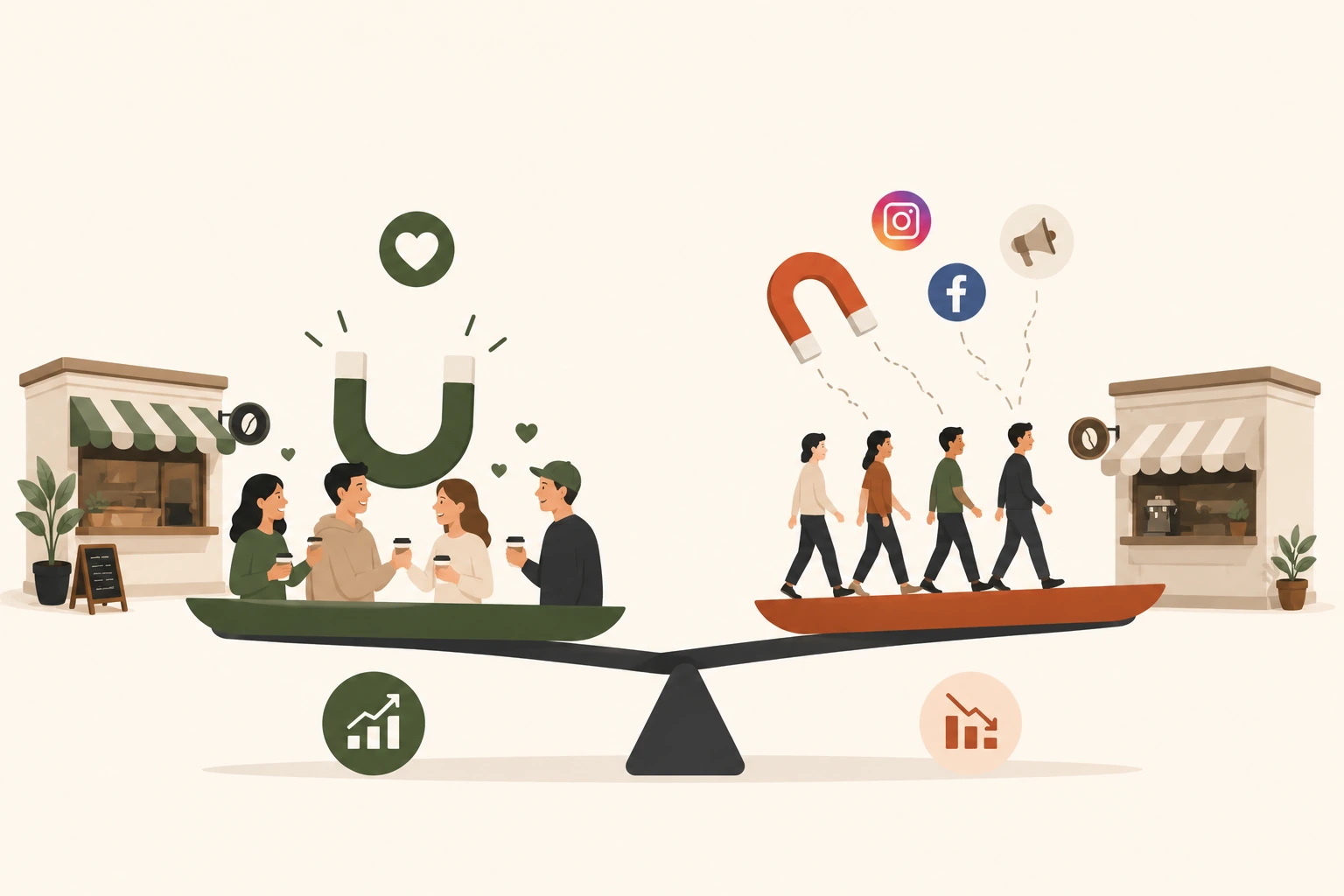
The takeaway: for most independent cafes, retention marketing (getting existing customers to visit more often) outperforms acquisition marketing (finding new customers) by a wide margin. So we're going to start there.
1. Build a loyalty program customers actually use
The single highest-return marketing move for most cafes is a working loyalty program. Not because it's flashy, but because it does three things at once:
- Rewards existing customers, so they visit more often
- Gives you a customer list (email addresses) you can use for other marketing
- Creates a moment of interaction at your counter that stamps your brand into their memory
The trap is that "loyalty program" often gets built badly. A paper card that gets lost in a wallet. An app that customers refuse to download. A points system so complicated your baristas can't explain it. Any of these fail because they add friction, and friction beats reward every time.
What a good cafe loyalty program looks like in 2026:
- Digital, not paper. Paper cards get lost, left at home, or forgotten at the bottom of a bag. The lost-card rate is easily 40-50%. Every lost card is a lost customer.
- No app to download. Customers won't install a new app just for your cafe. Look for tools that work in a browser or in Apple/Google Wallet.
- A clear reward. "Buy 6, get 1 free" is understood in three seconds. Points-based systems that require math to interpret get ignored.
- Fast at the counter. If it takes more than 5 seconds for a customer to collect their reward, staff will start "forgetting" to offer it.
We built Back Again because we couldn't find a loyalty product that met all four of those criteria in one place. Customers tap an NFC sign at your counter with their phone, their loyalty card opens in the browser (no download), and they collect a stamp in under 5 seconds. Other options we compare against in our best loyalty system for cafes post include Stamp Me, Square Loyalty, Loopy Loyalty, and Loyverse. Any of them will out-perform a paper card. Pick one and start.
2. Automated email: win-back and birthday campaigns
Once you have a customer list, the second highest-return marketing is automated email. Two campaigns matter more than any others:
The win-back email. When a regular hasn't visited in 3 or 4 weeks, they get an email with a small offer to come back. Something like: "We miss you. Pop back this week and there's a free coffee waiting."
The birthday email. On the customer's birthday, they get an email with a small treat available for that week. Something like: "Happy birthday, Anna. Come in this week and your coffee (and something sweet) is on us."
These two automations tend to run at 25-40% open rates and drive real repeat visits, because they arrive with a genuine reason for the customer to open (something for them). They're set up once and then run forever.
The manual version of this, where you write emails yourself, almost never happens. Cafe owners don't have time to write personalised emails to every quiet customer, and shouldn't. It has to be automated.
3. Google Business Profile: your unpaid storefront
Your Google Business Profile is probably driving more foot traffic than your Instagram is, and it costs nothing. If someone searches "cafe near me" or your suburb's name plus "coffee", Google decides what to show them based on your profile completeness, reviews, and photos.
The checklist that pushes you up the ranking:
- Complete every field. Hours (including holiday hours), phone, website, menu link, cuisine type, and payment methods.
- Post photos regularly. Not just of coffee. Include the inside of your cafe, food, staff, the exterior storefront (this helps people find you). Add 3-5 new photos per month.
- Reply to every review. Positive ones with a thank-you, negative ones with a professional response. Google's algorithm weights response rate.
- Use Google Posts. They're like mini social media posts on your profile. Announcing a new menu item, a seasonal drink, a weekend special. Under-used by cafes, easy to do.
- Systematically ask for reviews. More on this below.
Reviews are the single biggest lever. A cafe with 200+ reviews at 4.7 stars typically outranks a cafe with 30 reviews at 4.9 stars, because Google interprets review volume as trust signal.
How to get reviews without being awkward about it: the trick is timing. A customer just handed a coffee they love is your best moment. A customer opening their laptop to work for two hours is a bad moment. Most cafes rely on ad-hoc "please leave us a review" mentions, which get ignored.
Some digital loyalty platforms prompt customers to leave a Google review at the moment they collect a stamp (when they've just had a good experience). Back Again does this. It's the highest-conversion review-request mechanism we've measured. If you're on paper cards, this is another argument for going digital.
4. Instagram: quality of posts beats quantity
Instagram is where cafes waste the most marketing time. The instinct is to post daily, and the result is diluted, low-quality content that under-performs.
A better pattern:
- 3-5 high-quality posts per week, not 7 mediocre ones. Each post is a photo that would look good framed on a wall, not just okay on a phone screen.
- Show people, not just food. Faces get 38% more engagement than food photos alone on Instagram (per Instagram's own creator data). Staff mid-pour, customers laughing at a table, hands cradling a cup. Beats close-ups of flat whites.
- Use Stories daily, feed posts sparingly. Stories are lower-stakes and get seen by your regulars. Feed posts are for polished content that might reach new people.
- Reels for reach, feed for identity. If you want to grow your following, Reels are the vehicle. If you want to nurture existing followers, the feed is fine.
The single biggest mistake: posting your loyalty program on Instagram Stories once, then never mentioning it again. Your Stories are seen by your regulars, exactly the people who should be joining the program. Post about it monthly. Feature different rewards. Show real customers using it.
5. In-store signage that drives digital actions
Your best marketing surface is your cafe itself, because people are already there and already paying attention. Yet most cafes waste this surface with generic decor.
What actually works:
- A visible sign at the counter for your loyalty program. Big enough to see from the queue. "Tap to join our loyalty card" or similar. If the sign takes explanation, it's failing.
- A small QR code on the receipt or takeaway cup linking to your Google Business Profile with a pre-filled review prompt.
- A "seasonal special" A-frame or chalkboard, updated weekly. Not because customers will read the details, but because it signals "this cafe is active and cared for", which drives return visits.
- Menu cards on tables during off-peak hours. Customers linger over coffee. Give them something to read that isn't their phone.
The NFC sign for your loyalty card is the highest-leverage of these, because it converts foot traffic (which you already have) into a marketable customer list (which you probably don't).
6. Time-limited offers that actually work
Discounts and promotions are used badly by most cafes. A permanent 10% off doesn't feel special after a week. A "spend $20 get a free coffee" is confusing to communicate.
What works instead:
- Time-boxed offers with a real deadline. "This week: $10 toasties." Ends Sunday. Not "always available."
- Off-peak specific. A "morning power hour" (10-11am, 20% off) fills a dead time without cannibalising your peak.
- Bundle-based, not percent-based. "Coffee + croissant for $9" reads as a deal. "20% off breakfast" requires math.
- Communicated in the loyalty flow. Push offers to your existing customers through the same channel they use for stamps. They're the ones most likely to bite.
We built the timed offer feature in Back Again after watching cafes struggle to promote these campaigns effectively. When you set an offer, it appears on every loyalty card with an automatic countdown timer, and can be pushed via email to your regulars. If you're using a different platform, look for similar functionality.
7. Local partnerships with neighbouring businesses
The most under-used marketing in independent cafes is cross-promotion with businesses in the same neighbourhood. Your local yoga studio, hair salon, bookshop, and co-working space all have the same customer base you want.
Concrete patterns that work:
- The reciprocal punch card. Coffee at your cafe + service at their business = a small reward at both. Costs almost nothing to set up.
- The doorway offer. A small stack of your business cards at their counter (and vice versa), with a first-visit incentive. "Show this card for a free upsize."
- Event catering trade. Cater their team meeting or class in exchange for a shoutout to their customer list.
- A shared local map. A printed neighbourhood guide with 6-8 businesses your ideal customer visits. Everyone splits the cost. Everyone displays it.
These partnerships work best when the businesses are within a 5-minute walk of each other. Beyond that, the customer overlap drops off fast.
8. Consistent brand cues (the boring one that compounds)
None of the above works without a consistent brand. Not "logo and colour palette" boring brand advice, but the practical version:
- Your name on the takeaway cup. With your Instagram handle. Every walking customer becomes an ad.
- Consistent signage colours and typography across your storefront, A-frame, receipt, and social. A customer should feel like they're seeing the same cafe from every angle.
- The same photo style on Instagram for at least 6 months at a stretch. Consistency compounds; frequent style changes reset your brand recognition.
- Barista language matters. A friendly, specific greeting ("Morning Jack, the usual?") does more than a $500 Instagram ad, and it's free. Train for it.
Brand consistency is a slow compounding move. You won't see it on any month's revenue report. But cafes that get it right retain customers at meaningfully higher rates.
Common mistakes to avoid
We work with a lot of cafes and see the same missteps repeated. If you're doing any of these, stop first:
- Running a paper punch card in 2026. Lost-card rate destroys the ROI. Every option we cover in our comparison is better.
- Daily discount fatigue. Permanent discounts (10% off forever) train customers to wait for the discount rather than pay full price.
- Posting on Instagram without a hook. "Flat white today" is not a post. "New Ethiopian single origin, 30% brighter than our default. Try it Saturday morning" is a post.
- Asking for reviews at the wrong moment. After a coffee they loved: great. After a slow service moment or a complaint: catastrophic.
- Ignoring your Google profile. If it hasn't been updated in 6 months, it's actively hurting you.
- Trying to be on every platform. Instagram + Google + a working loyalty program covers 90% of what a cafe needs. TikTok, Twitter, LinkedIn are not worth the time for most cafes.
A 30-day starter plan
If you're starting from close-to-zero, here's a realistic sequence:
Week 1: Fix your foundation.
- Update every field on your Google Business Profile.
- Post 5 new photos to Google.
- Set up a digital loyalty program. Choose from options like Back Again, Stamp Me, Square Loyalty, Loopy Loyalty, or Loyverse. Post the sign at your counter.
- Take 10-15 high-quality photos of your cafe, food, staff, and drinks. Save them for the month's content.
Week 2: Turn on retention.
- Configure the win-back email (trigger after 21-30 quiet days).
- Configure the birthday email.
- Announce the loyalty program on Instagram Stories. Show a real customer using it.
Week 3: Systematic reviews.
- Set up a review prompt (either via loyalty platform or a printed sign with QR).
- Reply to every existing Google review you've never responded to.
- Post a Google Post about a new item or special.
Week 4: Local presence.
- Identify 3 neighbouring businesses with customer overlap. Have a coffee with the owners.
- Set up your first time-limited offer for the coming month.
- Review your Instagram: which 5 posts got the most engagement? Post more of that style.
After 30 days, most of the systems (loyalty, win-back, birthday, review prompts) run themselves. The remaining work becomes weekly maintenance: 3-5 Instagram posts, 1-2 Google Posts, checking one weekly report, replying to reviews.
Frequently asked questions
What's the best marketing for a small independent cafe?
Retention marketing beats acquisition marketing for cafes at every scale. Start with a digital loyalty program plus automated win-back and birthday emails. These two things together typically drive more repeat visits than anything else in the first year.
How much should a small cafe spend on marketing per month?
Most independent cafes should aim for 2-4% of monthly revenue on marketing, and most of that should go to retention tools (loyalty platform, email marketing) rather than paid acquisition (Google Ads, Meta Ads). Paid acquisition often fails to break even on a first cafe visit.
Is Instagram still worth it for cafes in 2026?
Yes, but with a quality-over-quantity approach. 3-5 well-crafted posts per week outperforms daily low-effort posts. Focus on faces and moments, not close-up food photos.
Do I need a website for my cafe?
Yes, but a minimal one. A single-page site with your hours, menu link, location, phone, and Instagram link. A Google Business Profile is more important than an elaborate website.
How do I get more Google reviews for my cafe?
Systematically prompt at the right moment. The best moment is right after a customer has had a great experience (received their coffee, enjoyed their meal). Some loyalty platforms including Back Again automatically prompt customers to leave a review after a stamp. Alternatives include a QR code on the receipt or a small counter sign.
What's the ROI of a cafe loyalty program?
For a cafe with 200 active regulars, a working loyalty program that increases visit frequency by 15% translates to roughly $12,000-$18,000 in additional annual revenue. Compare that to the $39-$79/month a modern digital loyalty platform costs.
Should I run Meta or Google ads for my cafe?
Rarely worth it for local independent cafes. The exception is if you're opening a new location and need a launch push. Otherwise, organic local marketing (Google Business Profile, loyalty program, referrals from neighbouring businesses) outperforms paid ads on a per-dollar basis.
How long before marketing efforts start showing results?
Loyalty program signups start on day one. Automated win-back and birthday email impact starts becoming visible in month 2-3 as regulars naturally cycle through their triggers. Google review count typically doubles within 60-90 days of systematic prompting. Instagram takes 6-12 months of consistent quality posting to move the needle meaningfully.
Where to start today
If you get one thing done this week, make it a digital loyalty program with automated win-back and birthday emails. That single change tends to be worth more than everything else on this list combined for a typical independent cafe.
Back Again is the platform we've built for exactly this. It's free until you have 50 customers, then $39/month AUD with no lock-in. If you'd rather compare options first, read our best loyalty system for cafes roundup where we honestly compare Back Again against Stamp Me, Square Loyalty, Loopy Loyalty, and Loyverse.